
'No expressions can do justice to my brave officers and crew; the calm courage they displayed during the cannonade, and the tremendous precision of their fire, could only be equalled by their ardour with which they rushed to the assault.' Captain Philip Broke of HMS Shannon, 6 June 1813
HMS Shannon was a 38-gun frigate that won immortal fame for her capture of the USS Chesapeake off Boston in June 1813. Since the 1750s, the term frigate had described the smaller, faster types of warship used for commerce protection or raiding, or scouting for the main fleet. They had two decks with the main armament carried on the upper deck. Completed in 1806, Shannon was a Fifth Rate 'Leda' class frigate mounting twenty-eight 18-pounder guns, the Royal Navy's largest type of frigate during the Napoleonic era.
To meet all its commitments the Admiralty gave priority to the construction of the greatest number of frigates, rather than those with the heaviest armament. Nevertheless, British admirals frequently complained that they did not have enough; while searching for the French fleet before the Battle of the Nile in 1798, Horation Nelson wrote to Sir William Hamilton: 'All my ill-fortune, hitherto, has proceeded from want of frigates.'
In the 1790s the Americans built some very large 44-gun frigates and when war broke out between Great Britain and the United States in 1812 these ships won a series of single-ship actions; USS Constitution captured HMS Guerriere and HMS Java whilst USS United States overwhelmed HMS Macedonian. The British public, accustomed to naval victories regardless of the odds, was incensed. However, since many of the best British ships and crews were in European waters, the defeats were not so surprising.
In response the British instituted a closer blockade of American ports. HMS Shannon commanded by Captain Philip Broke was one of the ships patrolling off the coast of the United States. During his seven years in charge, Broke had worked up his ship to a peak of fighting efficiency with the best gunnery drill of any vessel in the Royal Navy. His gun crews were trained to fire into the hull of the enemy ship to kill the crew instead of shooting down the masts. Throughout his career Broke had prepared for a single-ship action. He even refused to capture American merchant ships, as this would require him to put crews on board and reduce the Shannon's efficiency.
After a long patrol off Boston, Broke was rewarded on 1 June 1813 when the 38-gun frigate USS Chesapeake came out to challenge him. The ensuing battle was the finest single-ship action in the age of sail. Captain James Lawrence, the new commander of the Chesapeake, was confident in the ability of his veteran crew, but had reckoned without Broke and the Shannon.
As the Chesapeake approached, the Shannon fired her first devastating broadside at a range of about 35 metres. Lawrence was wounded, but ordered the Chesapeake to slow down to enable her to return fire. However, the American gunners did not have time to adjust their aim as the carronades of the British ship swept the Chesapeake's quarterdeck and on her upper deck two-thirds of the gun crews were already casualties.
At a crucial moment the Chesapeake's wheel was destroyed by a 9-pounder gun that Broke had installed on Shannon's quarterdeck for that purpose. Out of control, the vulnerable stern of the American ship was exposed to raking British fire and in desperation Lawrence ordered his men to board as the Chesapeake drifted stern first towards the Shannon.
Instead it was Broke who seized the moment and led the boarding party in person onto the Chesapeake. Despite a final appeal from Captain Lawrence 'Don't give up the ship!', the battle was effectively over. In a final act three American sailors, probably from the rigging, attacked Broke; he killed the first, but the second hit him with a musket and the third sliced open his skull before being overwhelmed.
The entire action lasted only 11 minutes, but its unequalled ferocity left 148 American and 83 English sailors killed or wounded. All the Chesapeake's officers were casualties and Lawrence died of his wounds three days later.
Broke made a miraculous recovery and returned to England where he received a hero's welcome for restoring the pride of the Royal Navy. Later in his career he made a decisive contribution to the establishment of professional standards of gunnery at HMS Excellent and laid the foundations for victories such as the attack on Acre in 1840. .
HMS Shannon was placed in the reserve in 1831. She was renamed the St Lawrence in 1844 and became a receiving ship at Sheerness, before finally being broken up in November 1859. But her name and that of Philip Broke will forever be associated for her swift and devastating victory over the Chesapeake.
Here are a couple models I built and painted of the two famous ships. models are 1:700 scale from the Skytrex 'Meridian - Trafalgar' range (
http://www.skytrex.com/ skytrex.com/
).
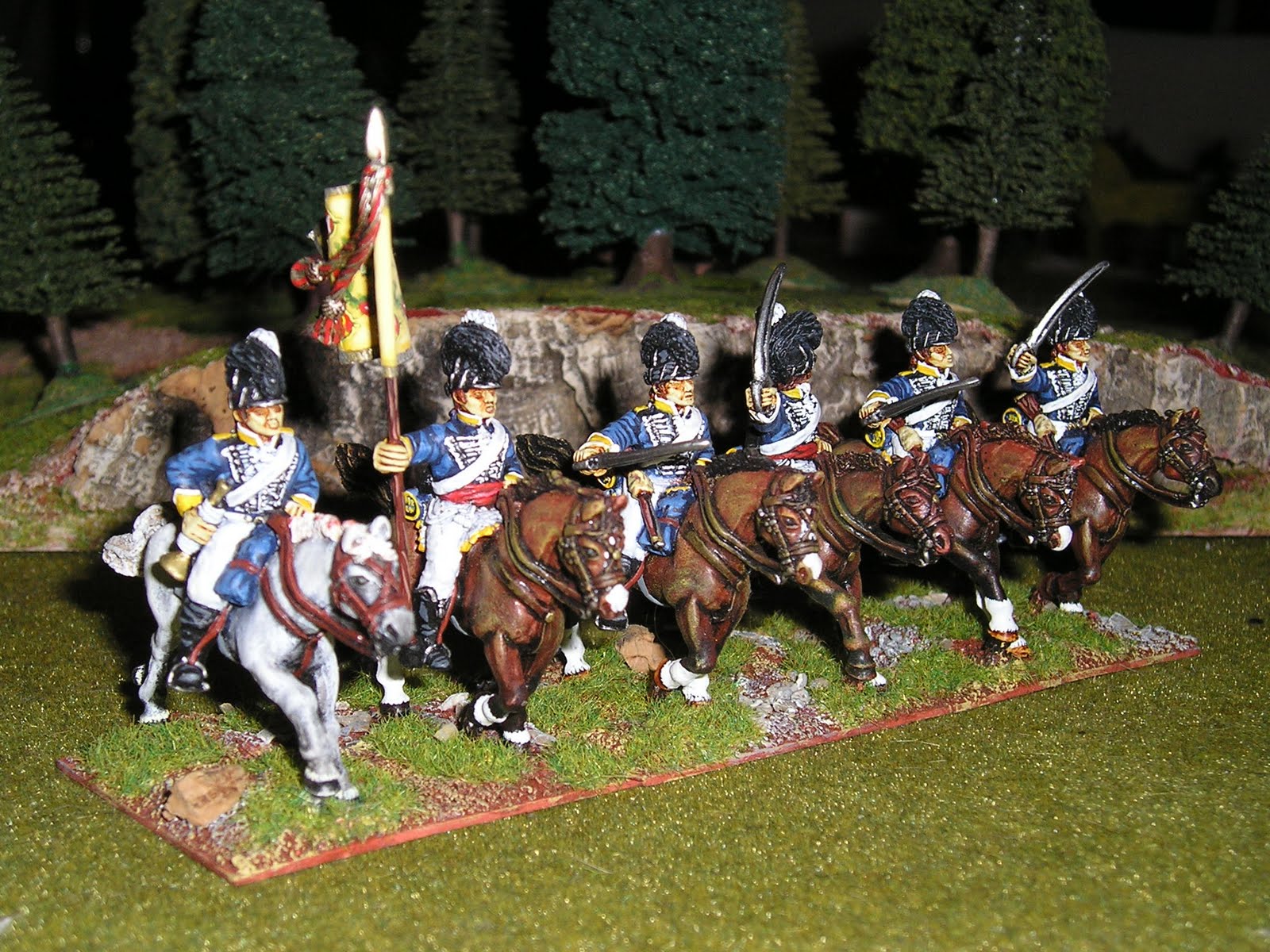
 As the Regiment was sent to North America in 1812 during the uniform change, I chose to portray them in the Tarleton rather than the new shako as I prefer the Tarleton.


