Thursday, 9 September 2010

Artillery redoubt

Just working on an 1812 skirmish scenario which requires an artillery redoubt so thought I'd better build one. 
First step is to cut out the base from chip board. Great way to recycle some old crappy furniture. 


Glued a few gabions in place. Gabions are from Hovels.  http://www.hovelsltd.co.uk/


Earth banking made from balsa wood. 


Gun platforms cut and glued in place then scored planking into them. 


Added some log protection.


Basetex applied. 


Sand dry brush on the soil. 


Made a few tools to scatter about the place. The shafts are made from cocktail sticks which are split at one end and then the card spades are slotted in.  Gun platforms painted with a watery flesh ink wash and the gabbions are painted sand and then given a chestnut brown ink wash.


Finished off with a bit of flock and leaf scatter. Will take some 'in action' pics later in week. 


Wednesday, 8 September 2010

15mm trees


I have been unhappy with K&M trees for some time but they have served their purpose. I wanted to make some more realistic looking trees but didn't want to spend a fortune. Having looked around, I discovered some tree armatures at the local model railway shop which weren't too expensive and it wasn't too difficult to throw them together to make some nice (I think so any way) trees and you can make loads from the pack. I also bought some additional flock to beef them up a bit but per unit, they still come in cheaper than K&M and I am much happier with them.


Thursday, 5 August 2010

Queen's Rangers Highlanders

Just finished this unit of Queen's Ranger's Highlanders. The figures are by Peter Pig.
http://www.peterpig.co.uk/

Wednesday, 4 August 2010

They always get their man!

These are figures by Redoubt http://www.redoubtenterprises.com/ from their Zulu War range and are in fact Natal Mounted Police which I have painted up as Royal Canadian Mounted Police for wild west / North West Rebellion games. I did a little converting by cutting off some of the pith helmets and replacing with pill box hats which I made from Milliput.
Since completing these, I have discovered that similar figures are produced by Empress http://www.empressminiatures.com/ and they are absolutely gorgeous. To expand my collection, I will definitely go with these.

Tuesday, 27 July 2010

Small fort

Here is another model which I made a while ago. The first step was to work out how big I wanted it to be and then to cut out an appropriately sized base out of chip board. I then glued polystyrene sheets to this with pva (pva doesn't chorode the styrene) and allowed a day or two for drying time. Once dry, you can easily sculpt the styrene to the desired contours.


Next thing I did was to start constructing an out building I wanted for inside the fort. I made the basic shape out of artist card and glued them together with super glue. You can use pva but the dry time is much longer. I then cut out and glued thin pieces of balsa to the outside of the construction and scored planking marks into it. After that, I added shingles and the door and window frames etc. The door handle is a shot gun pellet.

I now placed the block house in position on the board. You can build a blockhouse in the same way the out house was built but the one I used was bought from Redoubt Enterprises http://www.redoubtenterprises.com/
I then marked out where I wanted the palisade to go and then started sticking BBQ skewers along its track. I found that it made the structure stronger to tie them together near the top. That done, you can position the out house into place.

I wanted a firing step inside the fort so the next step was to work out how high it was to be and to place balsa supports for it along the inside of the palisade and other areas.

Now you can start to put the basing material down. First thing I did was to place several large rocks into the styrene and then I began painting on the basing material. I used a mixture of sand and brown emulsion paint for this.

You need to start painting now as there are parts you won't be able to get at once the firing step is glued in place. I used a leather brown colour which was then given a black was when it was dry.

That done, you can start building the platform for the firing step.

Finish painting the remaining parts and then when dry, dry brush the whole lot with a cream colour and maybe a little white. Go easy on the white though.

I also dry brush the basing material with an ochre colour and then add some rocky patches with a bit of a white dry brush. Again, go steady with this.

Next step is to flock the base whilst leaving a few bare patches. I also add a few areas of longer grass. All sorts of material for this can be bought from local hobby shops of model railway shops.

Saturday, 24 July 2010

Games Room


The WD3 crowd have been trading pictures of their respective games rooms so I thought I would also share some pics here. This is my little oasis and weekly battle ground.

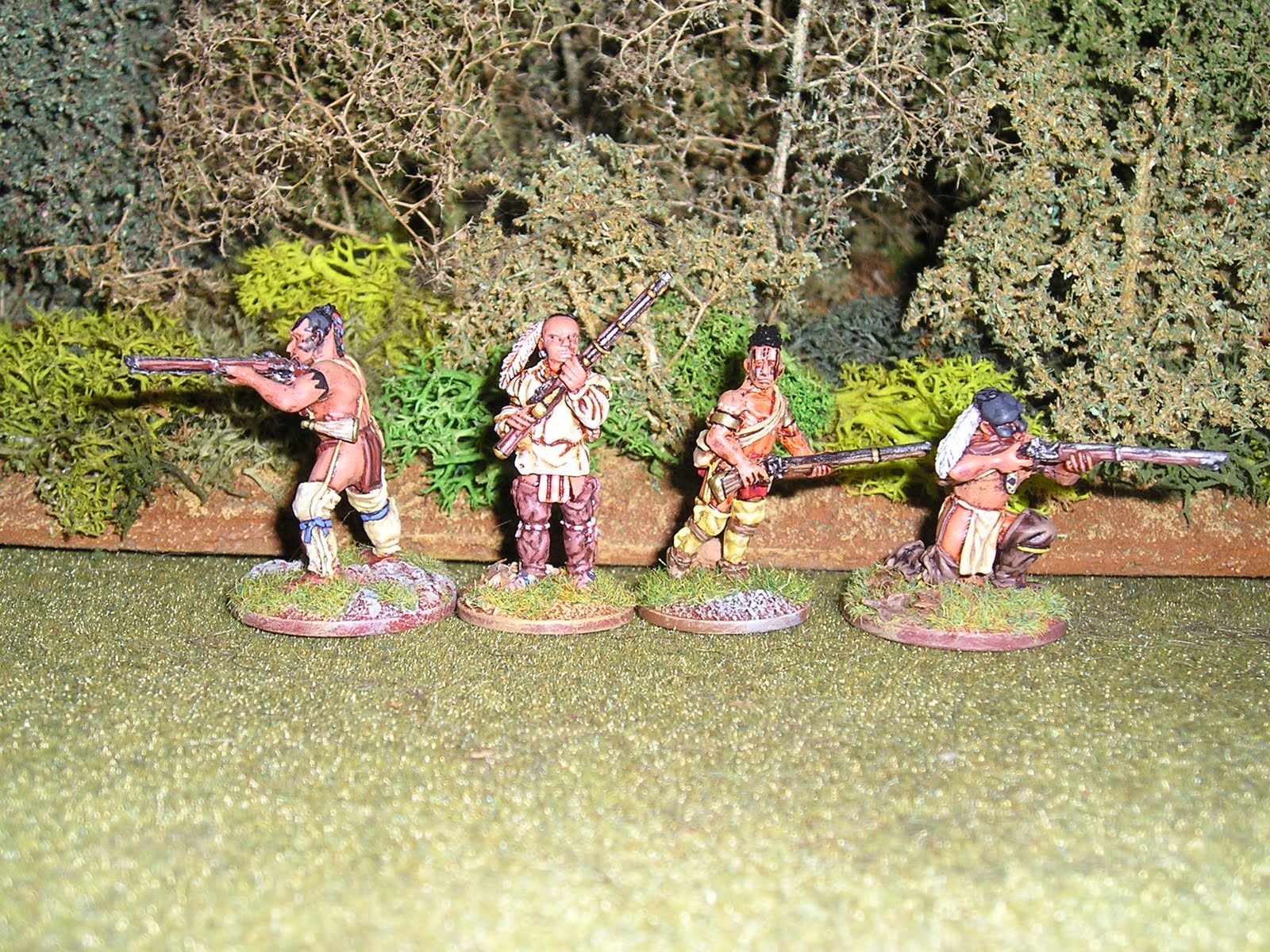
Redoubt Indians

Here is a selection of Redoubt Indians which are a little larger than the Perry Indians but mix in quite well as they are based individually. I really need to get the portage party. Maybe at the next show eh?

http://www.redoubtenterprises.com/

Perry Woodland Indians

These are some lovely figures from the Perry twins http://www.perry-miniatures.com/ and are part of their American War of Independence range but will, of course, cover a long period of time so I use them for Last of the Mohicans, French and Indian War and War of 1812 skirmishing.

Last of the Mohicans

Well, Last of the Mohicans is one of my favourite films, set in my favourite period so lets face it, you just have to game it don't you? It just stands to reason. I looked around for a generic set of skirmish rules for the period and stumbled across a set completely dedicated to the the film, which was nice.

I think most people are aware of the site where I downloaded the rules from but if you aren't, here is a link http://www.freewargamesrules.co.uk/
Its a great resource for free rules which you can try at no monetary risk. Here is a link to the Last of the Mohican rules http://homepages.paradise.net.nz/skarlet/mohicans/mohicans_rules.htm
Now, I do like this very simple set of rules but I will give you a word of warning. Hawkeye is indeed dead eye dick and Chingachgook will have you on the butchers slab before you can say pound of mince please. Knowing this, you can see that you're probably going to want a fair few baddies to take them on.
I have also taken the core rules and amended them slightly for general skirmish games in North America and they seem to work very well.
The figures pictured are painted by myself and are available from Conquest Miniatures http://www.conquestminiatures.com/ and you can also get a set from Redoubt Enterprises http://www.redoubtenterprises.com/ although, I have to say that I prefer the Conquest figures.

Friday, 23 July 2010

Lexington Belfry


This is the belfry which stood at Lexington. I believe this particular one (the original) burnt down and there is now a replacement there.

I don't do AWI skirmishing but I just fancied building this with the view that it could fit in with other North American skirmish games that I do do.

The first step was to come up with the correct proportions and establish a 'footprint' so that I could make an appropriate sized base to begin construction. I just came up with something which looked right to me rather than using any sort of mathematical formula. Having done this, I drew a rectangle on the base and then glued the uprights on all four corners in their places. Next step was to cut and glue the cross pieces and then the door way. I find that super glue is best for this as it sticks straight away, unlike pva.

The clapboard can now be fitted starting from the bottom with each successive piece overlapping the one under it slightly. Make sure that the width of each piece is the same with as between each upright. You can tackle this one side at a time. When finished, you should have gaps between each side running up the corners of the building. You now cut a single piece of balsa to fit into this gap making a clean, finished corner. You can also put the door in at this time.

I then made the bell tower construction. I made the bell from a solid piece of Milliput but you might find that you can buy an actual bell to serve the same purpose. I looked but couldn't find one. Remember to paint the inside of the building and also the whole bell tower before you glue in place as you will be able to see into the building when the construction is complete.

This done, you can glue in place the roof supports coming into the bell tower from each corner of the building. Now cut strips of roofing material and apply the same way you did the clap boarding to the side of the building. The only difference is that these need to but up to each other with no gap between them so you will need to do a layer at a time all the way around the roof from the bottom up.


The final part of the roof can now be sorted. You need a roof support coming from each corner of the top part of the belfry each meeting in the middle to form a peak. You can then apply the roofing timbers much the same as you did with the main roof section.

Now add some details to the door like hinges, latches etc. I used plasticard but you can use whatever you deem best.

Last but not least, paint and base. I painted the building brown and then gave it a black ink wash which, when dry was dry brushed with an ochre colour. Metal work was picked out in black. For basing, I use brown emulsion with sand mixed in which is then dry brushed with a sand colour and flock and leaf litter added.

Et voila!

If you don't fancy building one, you can also buy one from Grand Manner.